Psalm 116:1,2 I love the LORD, because He hears My voice and my supplications. Because He has inclined His ear to me, therefore I shall call upon Him as long as I live.
Psalm 116:1,2 I love the LORD, because He hears My voice and my supplications. Because He has inclined His ear to me, therefore I shall call upon Him as long as I live.
It’s a fundamental truth:
I called/ He heard me
I asked/ He answered
That’s why I trust Him
That’s why I always will.
I’m reminded of the song….
🎵🎵 I called, You answered And You came to my rescue And I, I wanna be where You are 🎵🎵
Simple enough… Enough for me. Simply HIS.
Psalm 116:1,2 I love the LORD, because He hears My voice and my supplications. Because He has inclined His ear to me, therefore I shall call upon Him as long as I live.
It’s a fundamental truth:
I called/ He heard me
I asked/ He answered
That’s why I trust Him
That’s why I always will.
I’m reminded of the song….
🎵🎵 I called, You answered And You came to my rescue And I, I wanna be where You are 🎵🎵
Colossians 3:1,2 Therefore, if you have been raised up with Christ, keep seeking the things above, where Christ is, seated at the right hand of God. Set your mind on the things above, not on the things that are on earth.
It’s an ironic verse given the barrage of ideas, images, hype and spin constantly assaulting our minds.
CS Lewis says that hell will be a place of constant noise. He might be on to something.
The point is that din all around us is illusion and delusion. It is all set out with flashy lights to distract us from what is really real.
Reality is the quiet peace of
His presence,
His love,
His plan.
Reality is eternity begun in the here and now.
Looking to live in light of reality. Looking to live in light of eternity.
Isaiah 43:11 I, only I, am the LORD, And there is no savior besides Me.
This verse from Isaiah has long stood as a clear and unwavering declaration of who God is. It was one of those verses committed to memory early on, not just for its rhythm or simplicity, but for its weight. The word “Savior” often brings to mind the image of Jesus on the cross, offering personal redemption and eternal life. That understanding is central to faith. Yet in this passage, the term carries a broader meaning. It speaks to God’s role in rescuing a nation, in preserving a people, in intervening when all other help fails.
Israel has always been at the heart of this promise. The history of Scripture shows God stepping in time and again to deliver, protect, and restore. That pattern continues. The need for divine intervention in Israel’s current situation is as urgent as ever. The threats are real, the divisions are deep, and the hope for peace often feels fragile. Yet the promise remains. God has not changed. He still saves.
There is also a sense that this promise extends beyond Israel. America, too, has experienced moments of divine mercy. The founding principles, the awakenings, the seasons of revival all point to a relationship that has been marked by grace. But something has shifted. The culture has grown restless. The nation has looked in many directions for answers, often ignoring the one source of true help. The result has been confusion, division, and a loss of moral clarity.
Still, there are signs of renewal. Some leaders are beginning to speak more openly about faith. Public moments, like memorials and gatherings, are starting to reflect a deeper hunger for truth. The legacy of voices like Billy Graham continues to echo, reminding the nation to turn back to God. His daily prayers for revival were not just personal—they were intercessions for a country in need of healing. After his passing, many others, including me, have picked up that task. Prayer must remain the response. Not just for personal devotion, but for national protection and spiritual awakening. The only Savior is still the same. No other source can offer what He does. That truth calls for humility, for repentance, and for hope. Whether in quiet moments or public witness, the direction must be clear. Look to the One who saves. There is no other.
Ephesians 2:3-5 Among them we too all previously lived in the lusts of our flesh, indulging the desires of the flesh and of the mind, and were by nature children of wrath, just as the rest. (4) But God, being rich in mercy, because of His great love with which He loved us, (5) even when we were dead in our wrongdoings, made us alive together with Christ (by grace you have been saved)
CHILDREN of WRATH (What a great description of our angry culture)
“But God”… so simple, but SO profound.
Brokenness, MERCY, LOVE, GRACE This verse is the Gospel in a nutshell.
Note who I WAS. Note who HE IS.
We are made whole not by what we have done or are doing…. but by GRACE through FAITH. If we cannot earn it, how can we lose it?
Like John MacArthur and RC Spraul used to say…. If I COULD lose it, I would. Thankfully, in his great love with which He loves us, he gives us MERCY and GRACE.
1 Samuel 17:47 … that all this assembly may know that the LORD does not deliver by sword or by spear; for the BATTLE IS THE LORD’S and He will give you into our hands.
The words are David’s (to Goliath just before he takes him out)
David has his sling, five rocks, unbelievable courage and eventually Goliath’s own sword.
Yet the BATTLE IS THE LORD’S.
Still looking for my sling. Still looking for stones. Still trying to figure out Which one is Goliath.
When approaching the book of Revelation, it’s important to recognize that readers often interpret its message through one of four major frameworks: Progressive Dispensationalism, Partial Preterism, the Historist view, and the Idyllic view. Each offers a distinct lens that shapes how the text is understood.
Progressive Dispensationalism sees Revelation as a roadmap of future events, with Christ’s kingdom already inaugurated but awaiting full realization. Partial Preterism interprets much of Revelation as fulfilled in the first century, especially in the fall of Jerusalem and the judgment on unbelieving Israel. The Historist view reads Revelation as a sweeping timeline of church history, with its symbols unfolding gradually across centuries. The Idyllic view, sometimes called the spiritual or symbolic approach, emphasizes timeless truths and recurring patterns rather than specific historical fulfillments.
These perspectives influence how a reader engages with John’s visions—whether as prophecy yet to unfold, history already fulfilled, a chronicle of spiritual struggle, or a poetic portrayal of divine victory. Understanding these views helps us appreciate the richness of Revelation and encourages thoughtful reflection as we explore its meaning.
But it is not only John’s work that is affected. The words of Christ are also viewed through the lens of the reader’s preference.
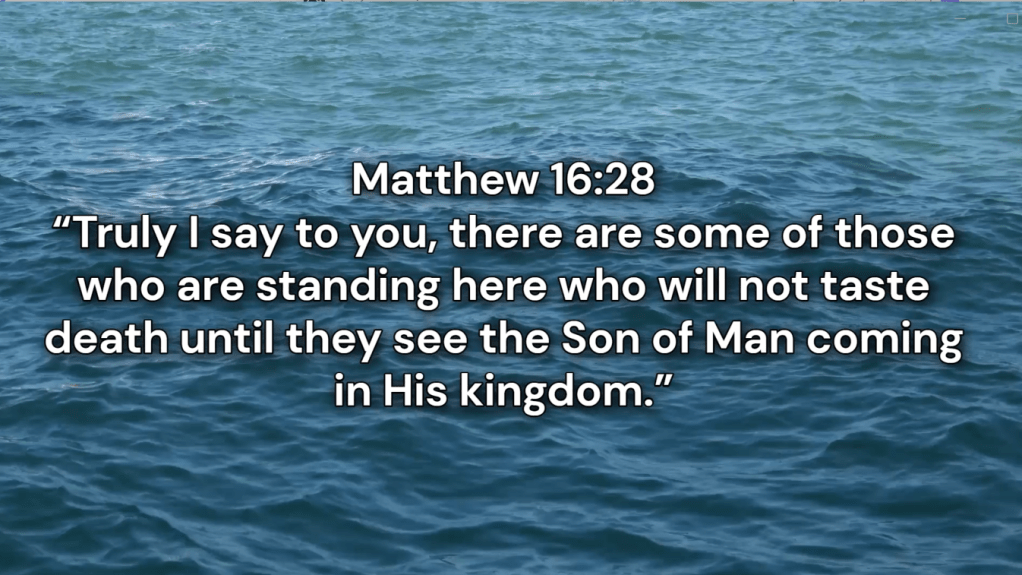
Matthew 16:28 presents a striking statement from Jesus, promising that some standing with Him would not taste death before seeing the Son of Man coming in His kingdom. This verse concludes a powerful sequence in chapter 16, where Jesus predicts His suffering, calls His followers to take up their cross, and speaks of future glory. The very next chapter, Matthew 17, opens with the Transfiguration, where Jesus is revealed in radiant glory before Peter, James, and John. Many scholars see this event as a partial fulfillment of the promise in 16:28, offering a preview of the kingdom through Christ’s glorified presence. The connection between the two chapters suggests that Jesus was pointing to a near-term revelation of His divine authority, not necessarily the final return.
From the perspective of Progressive Dispensationalism, Matthew 16:28 is often interpreted as referring to the Transfiguration as a foretaste of the future kingdom. This view holds that the kingdom was inaugurated in Christ’s first coming but awaits full realization in the future. The Transfiguration, then, serves as a visible confirmation of Jesus’ messianic identity and the reality of the kingdom already at work. Those who witnessed it saw the King in glory, validating the promise that some would see the kingdom before death, even though its complete fulfillment lies ahead.
Partial Preterism approaches this verse differently. It sees the “coming of the Son of Man” as referring to events within the first century, particularly the destruction of Jerusalem in AD 70. In this view, Jesus was speaking of His vindication and judgment against unbelieving Israel. The phrase “some standing here” is taken literally, pointing to the disciples who lived to see these events unfold. The Transfiguration may still be seen as a symbolic preview, but the primary fulfillment is historical and tied to covenantal transition.
The Historist view interprets Matthew 16:28 as part of a broader prophetic timeline. Rather than focusing on a single event, this perspective sees the “coming” as unfolding through church history, with various milestones representing Christ’s progressive triumph. Some within the early church may have witnessed the initial stages of this unfolding kingdom, such as Pentecost or the spread of the gospel, but the full scope is seen as ongoing. The verse is not tied to one moment but to a series of developments.
Lastly, the Idyllic view treats this passage as a theological affirmation rather than a specific prediction. It emphasizes the spiritual reality of Christ’s reign and the believer’s experience of His kingdom through faith. The Transfiguration, in this framework, is a symbolic representation of divine glory accessible to those who walk closely with Christ. The promise in 16:28 is fulfilled not through historical markers but through spiritual insight and communion with the risen Lord.
Matthew 16:28 invites reflection, but its meaning shifts depending on the lens through which it is read. Each interpretive view—Progressive Dispensationalism, Partial Preterism, the Historist approach, and the Idyllic perspective—offers a distinct context that shapes how the verse is understood. Whether one sees it as a preview of glory, a historical fulfillment, a prophetic unfolding, or a spiritual truth, the view held will guide how the passage is experienced. This diversity reminds me that scripture often speaks on multiple levels, and careful study helps us see more clearly what God may be revealing.
Ephesians 6:12 ” For our struggle is not against flesh and blood, but against the rulers, against the powers, against the world forces of this darkness, against the spiritual forces of wickedness in the heavenly places.”
A stark reminder:
Evil is real
The battle is personal.
The good news is that the next verse says ‘STAND’ and tells you how to do it… But it starts with knowing this is a BATTLEGROUND, not a playground.
Some folks know that better than others.
The REALLY good news is that “The battle belongs to the Lord.” But we have to “Armor Up,” because the Evil one has barbs and snares…. tricks to ensnare us, and lies to convince us that we are in some other sort of battle, and be caught unawares.
Why worry about our flesh and blood… it is the spiritual part of us that is eternal.
Isaiah 44:2 Thus says the LORD who MADE you And FORMED you from the womb, who will HELP you, ‘Do not fear, O Jacob My servant; And you JESHURUN whom I have chosen.
That’s quite the list of God’s involvement. He
made us
developed us
helps us
It’s quite amazing.
But more amazing still… He gives us a NICKNAME (JESHURUN is Gods pet name for Israel)
Now that’s intimacy.
I’m reminded of the “Sons of Thunder” name Jesus gave the Zebedee brothers.
I wonder what God’s nickname is for me… for you. Sleepy? Rocky? Punchy? Slim? Joy?
Matthew 5:11,12 “Blessed are you when people insult you and persecute you, and falsely say all kinds of evil against you because of Me. Rejoice and be glad, for your reward in heaven is great; for in the same way they persecuted the prophets who were before you.
When you are in the middle of a mess… this verse is a great promise.
When things are relatively good… this verse is a stern warning.
This last beatitude seems like He’s doubling down on the last point(and maybe He is)
The point is, you have become part of a long line of misfits and whackos who, because of their walk with Him, have turned the world on its head…

 Between the Garden and the Garden City